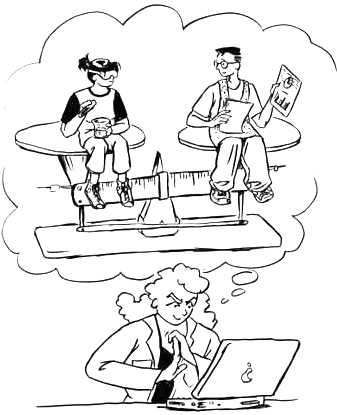
Woman at computer, thinking about female and male math and science students on either end of a balance scale.

July 01, 2009

Why are there so few women in science (and auto racing)?

People have been asking me this question a lot lately and I'm getting really tired of it. It would have been (and was) a good question 30 years ago. It's not now. Today there aren't so few women in science; there are so few women in some areas of science- like the physical sciences and engineering. There are now lots and lots of women in other areas of science. Ah the life sciences spring to mind—you know an area of science where the majority of students (grad and undergrad) are women.

Today the real question is "Why are there so many women in the life sciences and so few women in the physical sciences and engineering?" and that's the one we should be answering (regardless of what we are asked).

I'm not sure what the right answers are but I am sure know some wrong ones:

Wrong answer 1. "Women aren't interested in physical sciences and engineering." Right just like in the past women didn't go into life sciences, medicine, law or work outside of the home, because we weren't interested. We sure are interested now; what changed?

Wrong answer 2. "Women don't have the abilities to go into physical sciences and engineering." At the risk of being repetitious, right just like in the past women didn't go into life sciences, medicine, law or work outside of the home, because we didn't have the abilities. We sure do now; go read Janet Hyde.

The life sciences—now they're a lot like drag racing (that's sentence that I'll bet has never been written before). In 1976 Shirley Muldowney become the first woman to win an event in the National Hot Rod Association's fastest division (that would be top fuel cars for you not in the know). She went on to win 17 more events and three series championships. She's been followed by dozens of women (over 40 running nationally in the 2007 season alone). And they win. Pro stock bike driver Angelle Sampey has won 41 races and three series championships while Ashley Force Hood is the points leader for this year's funny cars.

If drag racing is the life sciences; Indy cars are the physical sciences. In 1977 Janet Guthrie became the first woman to compete in the Indianapolis 500; In the 32 years since then there have been only four other women who have run Indy cars. Now I know that Danica won a race in Japan and is fifth in the points standings this year and that Sarah Fisher is a driver owner, but that's not a lot of progress in what's been a lot of years.

And NASCAR, that's got to be mechanical engineering. In 1977 Janet Guthrie ran 19 NASCAR races (yes that would be the same Janet Guthrie; she was pretty busy in 1977). The last time any woman ran a national NASCAR race was in 2005.

So whether it's science or auto racing, the question should be "Why are more women in and more successful in one subfield and not in another?" Now that's a good question; one that we should be asking and doing our best to answer.


June 30, 2009

Just sayin

My favorite undergrad prof (Father Bosch--hey it was a Jesuit College) wrote in what was a wonderful letter of recommendation, "if you want someone with compassion for the less than competent or the lazy, she is not for you."-- I think he called me a "tiger in your tank"; and unlike my grad adviser; he didn't say a word about how attractive he thought I was

All these years later I continue to think of that as the best complement I ever received (and yes several years ago I found his e-mail and told him that) BAD ATTITUDES RULE!

PS This month's Scientaie is about who you see when you look in the mirror. You know after all these years, I'm kinda hoping that still is who I am.


June 24, 2009

So what creature would do this?

I need your help. Last Tuesday we left in the early morning for a flight to Austin for WEPAN. As we often do, when we are leaving early in the am, instead of digging up the compost heap, we left the organic garbage in a pan in a shed with a wood and glass door. When we got home we found that some determined creature (or creatures) broke out a piece of glass in the door (about 2.5 feet from the ground) and gnawed a triangular hole in the wooden part of the door (4 inches x 5 inches x 6 inches), about 9 inches from the ground.

The creatures then took ALL of the organic garbage out the shed (all that was left in the pan was some peat moss we use for bedding) and then outside in the yard, decided what things to take (ie. chicken bones, dying veggies etc) and what things to leave (i.e. banana peels and coffee grounds).

So friends, who did this? The holes are too small for raccoons, it seems too ambitious for squirrels (who are pretty fat and lazy from all the bird food they get under the bird feeder). Any and all suggestions welcome.

Thanks


June 23, 2009

Title IX: A happy birthday and a history lesson

Title IX is 37 today (well unless you count from when the regulations went into effect as opposed to Title IX's passage-what can I say, I'm a total geek).

The language of Title IX is simple "No person in the United States shall, on the basis of sex, be excluded from participation in, be denied the benefits of, or be subjected to discrimination under any education program or activity receiving Federal financial assistance." ; the ramifications huge.

So let me take you down memory lane to a pre Title IX time.

Cooking vs building--: In middle school I had to take Home Economics and could not take Shop. It didn't matter what I wanted to do or learn (cooking-other than chocolate chip cookies- not an interest; how things worked a total interest-- too bad). I was a girl (well I still am) and therefore I was REQUIRED to take Home Ec and FORBIDDEN to take shop.

Athletics-- I could play intramural basketball, as in only against your female school mates. That would be girls' basketball, which meant the middle of the court was like the great wall of China. Team A forwards and Team B defense players were REQUIRED to stay on one half of the court and vice versa. I don't know, maybe they thought we would get the vapors if we ran the whole court or dribbled more than three times in a row (that was another rule). There were a couple of "play days" with girls from other schools but no contact sports-- I played ping pong for my high school on those days. And oh yes, while I wasn't allowed to run track; I was allowed to do timing and scoring while my boyfriend ran.

Careers--So I was thinking about majoring in engineering; not like hugely compulsive I MUST BE AN ENGINEER but I thought that would be a good major for me. Since I had scholarships that could only be used in New York State, I checked things out and believe me preweb it wasn't easy. My choices were limited-- Cooper Union where if I could get in I would have to get my own apt in NYC and my parents- not so happy about that. RPI but I wouldn't be allowed to live on campus because I was, well yes, a girl. (Ah and to think Shirley Ann Jackson is now the president of RPI-- now that is progress.) So I went to LeMoyne College and majored in math instead.

My life continues to be great and I'm not complaining. I am however pointing out how much things have changed since Title IX.

Happy birthday Title IX and thank you.

PS sorry for the lack of postings; was in Austin for WEPAN and the totally cool bats!


June 15, 2009

I totally stole this from Zuska

I was going to write a post telling folks to go over to Kim's at All of My Faults Are Stress Related (which continues to be my nominee for best blog title EVER); but since the fabulous Zuska already did it , I'm just going to steal (hmmm maybe disseminate is a better term) her request.


Kim at All of My Faults Are Stress Related asks:

I've got a question for women readers, especially those in the geosciences, environmental sciences, or field sciences: what do you get out of reading blogs? And if you have a blog yourself, what do you get out of writing it?

I'm asking because there's a session at this year's Geological Society of America meeting on "Techniques and Tools for Effective Recruitment, Retention and Promotion of Women and Minorities in the Geosciences" (and that's in the applied geosciences as well as in academia), and I wondered whether blogs (whether geo-blogs or women-in-science blogs or both) help.

Please do go read her post and, if you are a woman in one of the relevant research fields, leave your 2 cents worth in the comment thread. The post is a wonderfully written examination of Kim's reasons for blogging - you'll enjoy it on it's own terms, even if you don't want to contribute to the comments.


June 12, 2009

Men as Fairy Godmothers

Ok I lied, I didn't do the post I promised Tuesday night. Instead I stayed up till all hours of the night hanging out with friends. And we were at the Tabard Inn. It doesn't get much better than that. Along with wonderful food and wine, they even have a green roof!

The post I promised was about the session that Jenn, FarierScience friend Susan Metz and I did at NSF's big Joint Annual meeting on Tuesday.

Our goal: Make STEM gender researchers and advocates better at getting their message across to the media.
Other method: Role play, of course. Jenn played the naive researcher who has just done a study of men as fairy godmothers. Susan was the intrepid reporter and I was the stop action person. Every time Jenn goofed I stopped the action and asked the audience what Jenn should do.

It was a fairy tale in four acts:

Act I: Don't agree to an on the spot interview; research the journalist first.
Act II: Have a message and tailor it to your audience.
ACT III: Watch your language.
Act IV: Answer the question you want to answer; not necessarily the one you are asked.

Then all 140 people there had to write a response to a reporter's question: " I understand that the goal of your project is to increase the number of women in science and engineering; why is this important?"

We got some great responses including:

"Airbags"
"Diverse groups produce better results"
"Our world needs the intellectual talent of people of all backgrounds"
"Women's participation make all scientists better scientists"
"If the cure to cancer was in the mind of a girl, we’d miss it." Quoting Myra Sadker, who died of breast cancer.

Feel free to use them or better yet come up with your own and share. BTW we're going to do a similar version at WEPAN on June 18th If your going to be at WEPAN come join us. It's 11:15 in the Austin South Room of the Omni. This time FairerScience friend Kathryn Campbell-Kibler will be the stop action person and I'll be the evil reporter. Jenn will reprise her role as the hapless researcher


June 08, 2009

Live bloging JAM, day 1

I was planning to the do some live blogging from NSF EHR HRD JAM (the Joint Annual Meeting of the Human Resources Development but since the wireless is “llimited and low” conductivity; this is going to be semi-live. We are here for several different projects, ENGAGE , our AGEP evaluation capacity building project and our work with Fort Belknap College.

Lots of really good things happening including getting to hang out with Alice Pawley. Will post about our role playing session on dealing with the media tonight, it was great fun. Am off to another meeting.

Am now listening students from Tribal colleges describe their research. This young woman, Deborah Kirk, from Haskell is describing how she digitized the the Cherokee Trail of Tears. She is creating an interactive map so the Cherokee people can go back and at least see their homeland virtually. She has traveled along the trail GPSing it, taking pictures and collecting artifacts. She is giving a fascinating presentation interweaving the history and her work.

Now I'm listening to two students from Chief Dull Knife College talk about their research on improving water filters and some of the implications of good water filters for Indian reservations. Anyone can make the filters for very little money and they work!

Hmm live blogging is hard, esp for someone with my spelling and typing skills. Am going to stop and listen for a bit;


Three students electrical engineering students Southwestern Indian Polytech are next. They been developing a Geiger counter to be used in suborbital flights and they are testing it in their own rocket (with two other teams of students). They got to do the coundown for the rocket and deal with launch problems. Sadly the rocket never left the atmosphere and the parachute got ripped so the payload landed so hard that they couldn't retrieve their data. These three are great

out of battery, by
A big shout out to NSF TCUP program officer Jody Chase for setting this up. .